











Patient story
Penelope.
Watch & wait, then treatment, now in remission.
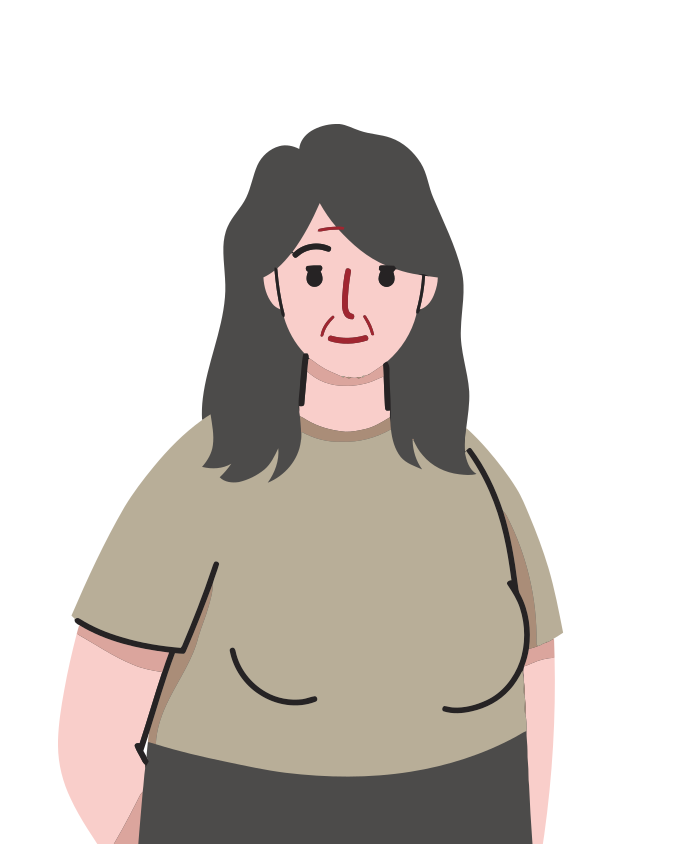
Penelope is 59 years old and she has been living with Chronic Lymphocytic Leukemia (CLL) since she was 50 years old. In the beginning, Penelope was in the “Watch and Wait” phase for 5 years. However, at some point, Penelope had constant bouts of fever and night sweats. The examinations revealed that CLL got worse. After this, she did a few extra examinations in order to find out which treatment is best for her. Penelope and her physician chose among the available treatments and she began targeted therapy. The treatment helped her and the symptoms gradually disappeared. Even though she still undertakes regular medical checkups, she is not taking any treatment. She continues her usual activities and feels quite happy.
Penelope’s path so far
5 stagesStage · Diagnosis
Diagnosis
You may have received a CLL diagnosis quite unexpectedly, following a regular check-up or upon medical examinations for certain symptoms. The diagnosis may have come as a total surprise to you as you may have never felt ill before and had no reason to suspect the disease. Every person has their own story.
In any case, the diagnosis might seem upsetting and scary at first. Take your own time to process the new information and what it means for you. Every reaction is different and that’s totally okay.
- What does “Chronic Lymphocytic Leukemia” mean as a term?
- What is one experiencing when they are diagnosed with it?
- What should you expect in the future?
- How can you deal with the psychological effects of your diagnosis?
Personal stories
1 item
-
“At first, when they told me I have leukemia I wasn't very well...It was out of the blue (…) the first thing I remember asking the doctor is whether it is contagious because I have children, and grandchildren (…) I was a mess, I was in my room, I wouldn’t get out, the whole family was by my side. Yet I slowly got over it and I started living life as I normal would”. (Maria)
Podcasts
2 items
-
Diagnosis Podcast in English
-
Diagnosis Podcast in Greek
Stage · Watch & Wait
Watch & Wait
Many people diagnosed with CLL do not need treatment right away. Instead, your physician will recommend regular check-ups and lab tests — a phase called active monitoring, or “Watch and Wait.” It can feel strange to live with a chronic condition without treating it. That feeling is shared by almost everyone in this stage.
- Why is treatment not started immediately?
- How often will I be monitored?
- What symptoms should prompt me to call my physician?
- How do I manage the anxiety of waiting?
Personal stories
3 items
-
“I am worried about the future, I don’t know what’s coming for me and I don’t know much regarding my own case, what happens next when it will get much worse, what therapy will I get, what treatment. I am not sure whether it is a good or a bad thing that I don’t know, but it stresses me out, for sure it does make me anxious, that I have no knowledge of what’s coming for me.” (Nikole)
-
“There are moments that you are inevitably thinking of [your diagnosis] and you wonder: “I don’t know what’s coming after”. Not knowing is the worst part. Ι say to myself that I am fine now, but what can it [CLL] cause in the future? Because I don’t know exactly what the outcome will be. (Andrew)
-
In the beginning my family was shocked, but they didn’t believe me because I didn’t have something serious and I didn’t need treatment. They were thinking that I might have something serious and I lie to them”. (Mike)
Stage · Prognosis
Prognosis
Typically, cancer prognosis is about overall survival. However, CLL is an indolent type of cancer, which slowly grows over the years. Despite being chronic, the course of the disease can be unpredictable. This can cause uncertainty and worries regarding the future.
Thanks to the development of new diagnostic techniques and the introduction of novel targeted therapies, the era of personalized medicine is here. Nowadays, there are prognostic tests which can assess which treatment is more effective for each individual. Before starting your treatment, you may be asked to undertake such lab tests. Their results will help your physician better assess the significance of your disease and identify the most suitable treatment.
- What are the available exams?
- Should everyone undertake prognostic test?
- What are the advantages and disadvantages of taking additional prognostic lab tests?
- How can you deal with the psychological effects of your diagnosis?
- How can you manage the emotions that may arise?
- What can you do to cope with uncertainty?
Personal stories
2 items
-
“The hematologist explained to me that I have this condition, Lymphocytic Leukemia. He told me that the diagnosis is good, and we have a very slow progression that can take up to 15 years… I was definitely in shock the day I found out. But I can’t say I panicked too much, because of the way he explained it to me, telling me that I was lucky in my misfortune for having this type of cancer”. (Helen)
-
The first tests showed the type of CLL, and I have to say that when my hematologist had all the data concerning the diagnosis, she told me quite early on that it is a type that has a really good prognosis. From the start, she was very reassuring. Twelve years have passed since then, meaning that this doesn’t bother me anymore. I think that it’s something you have, which, as I understood from my own experience, won’t cause any major problems. (George)
Podcasts
2 items
-
Prognosis Podcast in English
-
Prognosis Podcast in Greek
Videos
1 item
-
3:45
Chronic Lymphocytic Leukemia Biomarkers
Stage · Treatment
Treatment
Signs of CLL worsening include changes in the symptoms, the results of blood tests or certain findings from your physical examinations. These might indicate the initiation of treatment. A variety of factors will be considered in the decision of the appropriate treatment. The development and introduction of more effective, targeted treatments through the years has improved the lives of people living with CLL. However, the start of treatment might pose challenges and entail a variety of emotions.
- When might your doctor suggest treatment?
- When deciding treatment, what should you let your doctor know about you, besides your medical profile?
- What are the available treatments?
- What are some of the emotions and thoughts of people receiving treatment for CLL?
Personal stories
2 items
-
“I visited him after Easter, and he told me that we are going to start treatment in the summer. We started the treatment, and it went very well, after some years I started another treatment, and it went very well too, painless. That was nothing to me, I was going out normally. Generally, it doesn't interfere with my life, I didn't change my life, it’s like I don't have this disease”. (Chris)
-
“Science has progressed, one shouldn’t give up. I have CLL for 13-14 years and I am really well. It hasn’t affected me in any way. Even when I had chemotherapy, it was painless. In the summer I went to the hospital for chemotherapy and then I would go swimming as if nothing happened”. (Jim)
Podcasts
2 items
-
Treatment Podcast in English
-
Treatment Podcast in Greek
Videos
1 item
-
4:19
Chronic Lymphocytic Leukemia Treatment
Stage · Remission
Remission
At some point after starting treatment for CLL you may experience a remission. Remission means that no signs of CLL progression can be detected any more, and symptoms that were troubling you may have subsided. In some treatment regimens, treatment is received until relapse. This means that a patient needs to continue the same treatment, despite remission. In other regimens, treatment is received for a specific period of time. Thus, if remission is achieved after the completion of the treatment regimen, no other treatment is needed. In any case, the phase of remission requires “active monitoring” with regular appointments and medical exams in order to ensure that remission remains.
Achieving remission can be a relief and bring positivity. However, being in remission can also entail worries and uncertainty regarding the future.
- What do you have to do during this stage?
- What do people in “remission” experience?
- What are some of the emotions and thoughts of people being in remission?
- What can you do to cope better?